

If your dog or cat keeps throwing up every few days or even every few weeks, that is a chronic GI pattern, not a string of unrelated upset stomachs. The body usually clears a single dietary indiscretion within a day or two, so when vomiting cycles back on a predictable schedule, something underneath is driving it. Food sensitivities, inflammatory bowel disease, parasites, pancreatitis, and certain endocrine problems can all show up this way, and the picture sharpens when you also see weight loss, appetite changes, or intermittent diarrhea. The only way to sort one cause from another is a stepwise workup, because a recurring problem is rarely solved by a single bland-diet weekend.
East Wind Animal Hospital in Willow Grove is built to run the full chronic GI workup in-house before any referral is on the table. Our in-house lab, digital X-ray, and ultrasound let us screen for the serious causes first, then guide a structured food trial, and our internal medicine workups carry the case to the point where endoscopy or biopsy is the right next step. If your dog or cat has been throwing up on a recurring schedule, reach out and we will start the workup.
The Quick Rundown
- Vomiting that keeps coming back over weeks or months is a pattern that points to an underlying problem, not a run of unrelated stomach bugs that will sort themselves out.
- Chronic vomiting paired with weight loss, appetite changes, increased thirst, or intermittent diarrhea is your cue to schedule a visit rather than wait it out.
- The cause can live almost anywhere, from the food bowl to the kidneys to the intestinal lining itself, so the answer comes from a stepwise workup rather than a single test.
Which Vomiting Signs Mean Call Now Versus Book Soon?
Not every episode carries the same weight. Some vomiting needs a same-day response, some belongs in a scheduled appointment, and the details you record at home help your veterinarian sort one from the other before a single test is run.
When Is Vomiting an Emergency?
Some vomiting cannot wait for a scheduled slot. Call us right away or head to the nearest veterinary ER for vomiting of blood (bright red or coffee-ground), a swollen or painful belly, unproductive retching that brings nothing up (especially in deep-chested dogs), an inability to keep even small sips of water down, severe lethargy, or any of these signs in a very young or very old pet.
We provide emergency and urgent care during our regular hours, and online check-in lets you hold your place from home. Outside those hours, a critical case should go straight to the nearest 24-hour veterinary emergency hospital.
When Should a Vomiting Pet See the Vet?
Once the emergency signs are ruled out, schedule a visit when the vomiting has been repeating over multiple weeks, especially alongside another change. A single off day usually sorts itself out; a pattern does not. These companions to the vomiting move it firmly into appointment territory:
- Vomiting across multiple weeks: A recurring schedule is the pattern we most want to see.
- Unexplained weight loss: Dropping pounds without a diet change deserves a look.
- Increased thirst or urination: These can flag an organ or endocrine problem behind the nausea.
- Low energy or appetite shifts: A pet who is off their food or unusually flat needs attention.
- Concurrent diarrhea: GI signs on both ends point to something more than a passing upset.
In cats, frequent hairballs are worth taking seriously rather than shrugging off, since more than one every month or two can signal a problem in the gut rather than normal grooming. Age raises the stakes too, because organ diseases that come with senior health changes frequently announce themselves as chronic vomiting before anything else.
What Does the Look and Frequency of Vomiting Tell You?
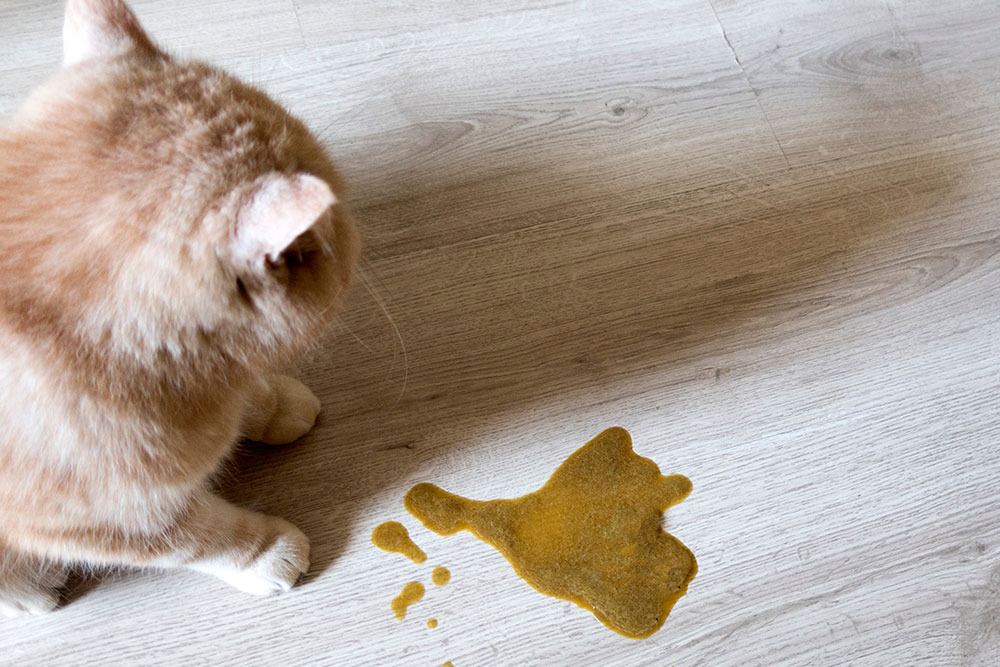
What comes up, and how often, is real clinical data, so a little note-taking at home goes a long way. Jot down the timing, how soon after eating it occurs, and what the material looks like. A quick phone photo is genuinely helpful. The appearance of vomit carries real clinical information:
- Yellow or green bile: Often means an empty stomach, sometimes tied to a long overnight gap between meals.
- Undigested food: May come back up soon after eating, raising the question of eating too fast or a swallowing problem.
- Dark or coffee-ground material: Suggests digested blood, which warrants prompt attention.
- Bright red blood: Points to fresh bleeding in the upper GI tract and needs a same-day look.
- Foamy white liquid: Usually stomach fluid and mucus, common on an empty stomach but worth tracking if it repeats.
One distinction matters early. Undigested food that comes up without any abdominal heaving is often regurgitation rather than true vomiting, and it can point to an esophageal condition like megaesophagus. Vomiting involves active retching and abdominal effort; regurgitation is passive. Telling us which one you are seeing helps steer the workup.
Can You Fix Vomiting at Home Before It Becomes a Medical Case?
Two of the most common triggers are things you can address without a prescription, and they are easy to miss because they mimic medical problems almost exactly. A pet who eats too fast or lives with chronic stress can vomit just as reliably as one with organ disease, but the fix is entirely different.
Is Your Pet Eating Too Fast?
Some pets inhale a meal so fast that food comes straight back up, barely digested, within minutes. The affectionate name for it is “scarf and barf,” and it shows up most in multi-pet homes or in pets who once went hungry. The vomit looks alarming but the pet acts fine. The fix here is structural, not medical: interactive feeders that make a dog or cat work for each bite slow an eater down, and feeding pets separately plus offering smaller, more frequent meals both help too.
Can Stress and Anxiety Cause Vomiting?
Chronic stress is an underrated driver of GI upset, and it hits cats especially hard. Feline stress from a new routine, a new household member, or ongoing tension can produce vomiting that looks exactly like a medical problem. Because it is indistinguishable from the medical kind on the surface, we look for the company it keeps: stress often travels with behavior shifts like hiding more, overgrooming to a bald patch, or a change in how your pet interacts with the household. When the vomiting and the behavior changes track together, stress moves up the list.
Why Does a Pet Vomit for Weeks on End?
When at-home triggers do not explain it, chronic vomiting rarely stays a single-system problem. The cause can sit in the food bowl, in an organ far from the stomach, or in the GI tract itself. Getting a clear answer often takes more than one visit and more than one test.
Each of those possible causes calls for a different treatment, so the right diagnosis has to come first. That is why our team provides expert internal medicine for complex GI cases, so we can keep working on the problem until we have an answer.
Can Food and Diet Cause Chronic Vomiting?
Food is one of the most common contributors to chronic vomiting and, oddly, one of the last things families think to question. A true food allergy is an immune reaction to a specific protein and a food intolerance is a digestive one, but both can drive recurring vomiting, and rotating brands and shared table food make the trigger nearly impossible to pin down.
On the other side is dietary indiscretion, from raiding the trash to swallowing an object outright. Fabric and small toys can cause partial GI obstructions that let some contents pass and produce on-and-off vomiting. When imaging points that way, our team performs surgical removal of obstructions.
When Is Vomiting a Sign of Organ Disease?
Vomiting is not always a stomach problem. Several conditions outside the GI tract trigger nausea as a side effect, and each needs its underlying problem named and managed, or the vomiting keeps coming back:
- Chronic kidney disease: Kidneys lose filtering ability, so waste builds up in the blood and drives ongoing nausea.
- Liver and gall bladder disease: Disrupted bile flow and detox upset the stomach.
- Hyperthyroidism: An overactive thyroid, mostly in cats, speeds up metabolism and provokes GI upset.
- Pancreatitis: An inflamed pancreas lets digestive enzymes irritate nearby organs.
- Addison’s disease: Underactive adrenal glands, mostly in dogs, producing waxing and waning vomiting and appetite loss that can mimic primary gut disease for months.
Which GI Tract Disorders Cause Chronic Vomiting?
Once systemic causes are ruled out, attention turns to the GI tract itself, where the diagnosis really matters because the treatments diverge so sharply. Inflammatory bowel disease (IBD) rises to the top, driven by chronic inflammation of the intestinal lining that will not settle with a bland diet alone. Several other primary gut conditions belong on the list:
- Lymphoma: GI lymphoma is a common cause of chronic vomiting and weight loss in older cats, and is hard to differentiate from IBD.
- Gastric ulcers: Erosions in the stomach lining that can bleed and cause coffee-ground vomit.
- Bilious vomiting syndrome: Classic early-morning bile episodes, where an empty stomach sits too long overnight and a late snack often fixes it.
- Pyloric stenosis: A narrowed stomach outlet that slows food from leaving and triggers vomiting.
- Gastric cancer: Less common but serious, presenting as gradual, persistent vomiting and weight loss.
These conditions can look alike from the outside, so telling them apart depends on pairing our diagnostic findings with the details you notice at home. Your observations are half the diagnosis.
How Do We Track Down the Cause?
The workup starts with a thorough history and a hands-on physical exam, then moves to baseline diagnostics that screen the whole picture at once. Each test answers a specific question, and the goal is to rule the serious causes in or out before anyone reaches for a diet trial or a scope.
- Bloodwork: Screens organ function, blood cell counts, and clues to systemic disease.
- Urinalysis: Checks kidney concentration and flags problems bloodwork alone can miss.
- Fecal testing: Looks for parasites and other intestinal culprits that are easy to overlook.
- X-ray, sometimes with barium: Checks for obstructions and structural problems.
- Ultrasound: Shows the layered detail of organs and the GI wall that flat images cannot.
One quiet advantage helps enormously here: wellness baselines. When we have prior lab values from a healthy visit, a small shift becomes meaningful instead of a number floating without context.
What Is an Elimination Diet Trial for Chronic Vomiting?
When baseline testing does not name a cause, a structured elimination diet trial using a novel or hydrolyzed protein becomes the next step. It doubles as both test and treatment, and it works only when you keep it strict for the whole run.
A novel protein diet uses a protein your pet has never eaten, so the immune system has nothing to react to. A hydrolyzed protein diet breaks the protein into pieces too small for the immune system to recognize. Either can work, but both live or die on discipline: no treats, no table scraps, no flavored medications, and no sharing food with other pets. Even a few bites can invalidate weeks of effort, and over-the-counter limited-ingredient foods do not cut it, since cross-contamination during manufacturing routinely sneaks in trace amounts of other proteins.
What Do Endoscopy and Biopsy Reveal in Chronic Vomiting?
When initial testing and a diet trial have not produced an answer, advanced procedures take a direct look at the tissue itself. These are the steps that finally distinguish one lookalike condition from another, and there are a few routes to get there.
What Is Endoscopy?
Endoscopy uses a flexible camera passed under anesthesia to look directly at the upper GI tract and collect small tissue samples along the way. It is minimally invasive, recovery is typically quick, and there are no external incisions to heal. It is the right call when initial testing has not found the cause or when the GI lining needs a direct visual assessment. Endoscopy is performed through referral to a specialty center, and we coordinate that step and interpret the results with you.
What Is Exploratory Surgery and GI Biopsy?
Exploratory surgery opens the abdomen so the surgeon can examine the organs directly and collect full-thickness samples from several points at once, capturing the entire wall to reveal conditions that shallow endoscopic samples can miss. It becomes the preferred route when imaging turns up an abnormality, when full-thickness tissue is needed for an accurate diagnosis, or when a blockage or mass needs to come out anyway. Our team performs exploratory abdominal surgery when a case calls for that level of access.
What Do Biopsy Results Actually Tell Us?
Telling IBD apart from intestinal lymphoma, other GI cancers, infections, and different inflammatory patterns comes down to histopathology, the microscopic study of the tissue. This distinction is not academic. Because the treatments for these conditions differ entirely, a precise tissue diagnosis lets us aim therapy at the actual problem instead of guessing.
How Is Chronic Vomiting Treated Once You Know the Cause?
Treatment follows the diagnosis, and three broad pathways emerge depending on what the workup finds. Whether the answer is food, inflammation, or a systemic organ problem, we map out the best plan for your pet based on the diagnosis and a conversation with you.
- Food-responsive vomiting: Keep feeding the diet that worked. The catch is holding the line long term, with consistent household rules about treats and table food and a habit of checking the ingredient list, since manufacturers occasionally reformulate without fanfare.
- IBD: Usually a combination approach, pairing anti-inflammatory or immunosuppressive medications with dietary adjustments that support the gut while it heals. Response varies from patient to patient, so we adjust the plan as your pet does.
- Systemic causes: When an organ problem is driving the vomiting, the focus shifts to managing that underlying condition. Stabilizing the kidney disease, pancreatitis, liver problem, or overactive thyroid is what brings lasting relief and typically improves the GI signs.
Your Questions About Long-Term Vomiting
Is it normal for my cat to vomit hairballs regularly?
Occasional hairballs happen, but regular ones are not something to shrug off. More than one every month or two can signal an underlying GI problem rather than normal grooming. If your cat is bringing them up frequently, or vomiting between hairballs, it is worth a visit so we can check whether grooming is the whole story or something in the gut is contributing.
Why does my dog throw up yellow bile in the early morning?
Early-morning yellow bile is a recognizable pattern, often bilious vomiting syndrome. When the stomach sits empty too long overnight, bile can back up and irritate the lining, and your dog brings it up before breakfast. A small snack before bed frequently solves it. If it persists despite that, let us take a look to rule out other causes.
How long does a food trial take to show results?
A diet trial is a commitment, usually running several weeks to a couple of months, because the gut needs time to settle and the old triggers need time to clear the system. The hardest part is strict compliance the entire time, with zero treats or table food. Cutting it short or slipping mid-trial can send you back to square one. We will set clear expectations and check in along the way so you are not navigating it alone.
Let’s Find Out Why Your Pet Keeps Vomiting
Living with a pet who keeps throwing up, without knowing why, is genuinely draining, and a methodical, step-by-step approach is what cuts through it. That is exactly how we work a chronic GI case, and we stay with it until we have a real answer, not just a temporary patch.
You have been cleaning up after every episode; let us carry it from here, from the first round of bloodwork to a biopsy if that is where the trail leads.
If your dog or cat has been vomiting on a recurring schedule, book a visit and let us start the workup. Prefer to ask a few questions first? Reach out to our team and we will point you in the right direction. You do not have to figure this out on your own.







Leave A Comment