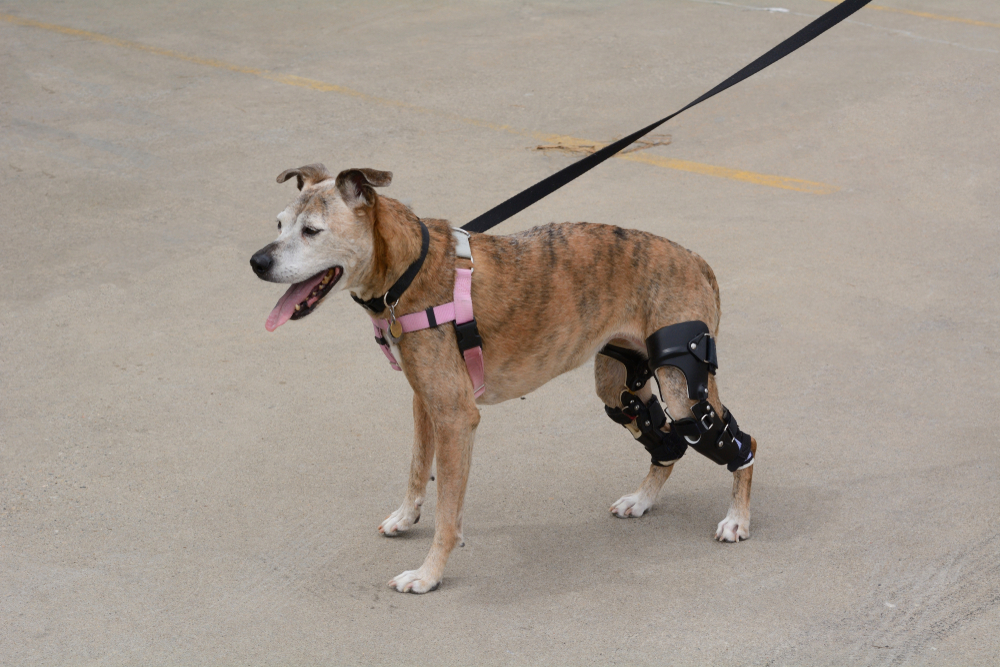
A torn cranial cruciate ligament will not heal on its own because the problem is mechanical, not the kind of injury rest and time can repair. The CCL is a stabilizing band inside the knee, and once it tears, the two ends cannot reattach across a joint that keeps moving with every step. Rest may quiet the pain for a while, and anti-inflammatories may help your dog seem more comfortable, but neither restores the stability the ligament used to provide. For most medium, large, and giant dogs, that is why surgery, not patience, is what returns the knee to reliable function.
At East Wind Animal Hospital, we diagnose cruciate injuries with a thorough orthopedic exam and in-house imaging, and we coordinate referral to a trusted board-certified orthopedic surgeon when surgical correction is needed. We continue your dog’s care through pre-op workup, post-op recovery, rehabilitation guidance, and long-term joint management, so you have continuity with your regular veterinary team across the whole process. If your dog is limping on a back leg or favoring a hind limb, contact us and we will get to the bottom of it.
Why Rest Alone Isn’t Enough: The Essentials
- A torn CCL is a mechanical failure; the ligament cannot reattach across a joint that never stops moving.
- Rest and anti-inflammatories can ease pain, but they do not restore the knee’s stability.
- Each step on an unstable knee grinds cartilage and drives arthritis, so waiting tends to make things worse.
- Most medium and larger dogs need surgery to return to comfortable, reliable function.
Why Can’t a Torn CCL Heal on Its Own?
The instinct to rest an injury and let it mend is reasonable for a strained muscle or a minor sprain, but a torn cruciate is a different kind of problem. The ligament’s whole job is to hold the joint stable, and when it fails, the knee becomes mechanically loose. There is no way for the body to bridge that gap on its own, because the torn ends sit inside a joint that bends and bears weight thousands of times a day, and that constant motion prevents the kind of healing a quieter tissue might manage. The torn ligament also sits bathed in joint fluid, which washes away the blood clot that would normally scaffold repair, so even the body’s usual first step toward healing never gets a foothold.
The result is a knee that stays unstable even after the initial pain settles. Many families understandably misread the signs, so it helps to separate what people hope rest will do from what actually happens.
| What people hope | What actually happens |
| Rest lets the ligament heal | A torn CCL cannot reattach, so the gap never closes |
| The limp eased, so the knee is better | The pain quieted, but the joint is still unstable |
| Anti-inflammatories fixed the problem | They mask discomfort; they do not restore stability |
| Short breaks let it recover | Every step on an unstable knee adds more arthritis |
This is why a dog can seem to improve, then relapse, again and again. The improvement is the pain easing, not the joint healing, and underneath it the instability keeps doing damage.
What Is Actually Happening Inside the Knee?
The cranial cruciate ligament is the canine equivalent of the human ACL. It runs diagonally inside the knee and keeps the shin bone from sliding forward against the thigh bone every time the leg bears weight. Unlike a human athlete who blows an ACL in one dramatic moment, dogs more often have a ligament that degenerates over months, its fibers weakening until enough fail that the joint gives way, sometimes during something as ordinary as hopping off the couch. Cruciate ligament injury in dogs is usually this slow unraveling rather than a single accident.
Once the ligament fails, the shin bone slides abnormally with each step, and that shearing motion grinds the cartilage and can tear the meniscus, the cushion inside the joint. The body tries to compensate by thickening the joint capsule, but that scarring stiffens the knee without truly stabilizing it. Certain dogs are more prone to the whole process, including Labradors, Rottweilers, Newfoundlands, Boxers, and German Shepherds, as well as overweight dogs and those with a steep tibial plateau that increases the strain on the ligament.
How Do You Know It’s a Torn CCL?
The signs depend on whether the tear is partial or complete. A complete tear often shows up suddenly as a dog who will not bear weight on a hind leg, while a partial tear produces an intermittent limp that comes and goes with activity and is easy to dismiss. Dogs with CCL trouble frequently sit with the sore leg kicked out to the side, hesitate at stairs or jumping up, stiffen after exercise, or show swelling at the knee.
Confirming it pairs a hands-on exam with imaging. The key exam finding is the cranial drawer sign, an abnormal forward slide of the shin bone that a tense dog may need light sedation to assess. Imaging fills in the rest of the picture:
- X-rays: show the bone and how much arthritis has already developed.
- MRI: reserved for complex cases where the picture is unclear.
Acting while the limp is still intermittent, rather than waiting for a three-legged dog, genuinely changes the outcome. The team at East Wind can handle the diagnostics and orthopedic exams to confirm cruciate ligament injury and rule out other causes of limping, like bone cancers, muscular injuries, or fractures.
What Does Rest-Only Management Actually Do?
For most dogs, rest-only management slows the problem without solving it. There is a narrow group for whom conservative care is reasonable: very small dogs under about 20 pounds, whose lower body weight lets natural scar-tissue thickening stabilize the knee enough for a quiet life, and dogs who cannot safely undergo anesthesia. For them, strict rest, anti-inflammatory medication, and controlled rehabilitation can produce an acceptable result.
For a medium or large dog, though, rest-only management usually means a knee that stays unstable and an arthritis process that keeps advancing. The dog may have better and worse stretches, but the joint never restabilizes, and the long-term outcome is consistently worse, and often more painful, than what timely surgery would have delivered. Choosing conservative care for a large dog should be a clear decision about comfort and circumstances, not a hope that the knee will quietly fix itself.
How Does Surgery Fix the Instability?
Surgery works because it addresses the mechanical problem directly. The most common procedure for medium and larger dogs, TPLO, reshapes the top of the shin bone so the joint is stable under load without needing the torn ligament at all, which is why it produces such reliable, durable function. A tibial tuberosity advancement (TTA) uses a related principle, and for smaller dogs an extracapsular repair (lateral suture technique) supports the joint from outside with a heavy suture, avoiding a bone cut. Each has its place depending on the dog’s size, activity, and anatomy.
Cruciate surgery is a specialty orthopedic procedure, and we refer surgical cases to a trusted board-certified veterinary surgeon who performs these procedures regularly with the equipment and expertise this level of work requires. Board certification (DACVS) is the highest credential in veterinary surgery, and for an orthopedic procedure that has to land precisely to produce a lasting result, the specialist setting is the right setting. We handle the referral logistics, send your dog’s records and imaging to the surgeon, and stay part of the care team throughout.
What Does Recovery Require?
Recovery is a staged commitment over roughly three months, and following it closely matters as much as the surgery itself. The early weeks set the foundation:
- Strict crate rest with leash-only bathroom breaks for the first weeks.
- Cone on until cleared for removal: The e-collar, or “cone of shame”, must be on at all times to prevent damage to the surgical site. For particularly persistent dogs, or dogs who can’t handle a cone, lick sleeves are a nice alternative.
- Gradually lengthening controlled walks as the repair allows, with most dogs returning to controlled activity around twelve weeks.
- Structured rehabilitation: consistently improves the final result over recovery alone.
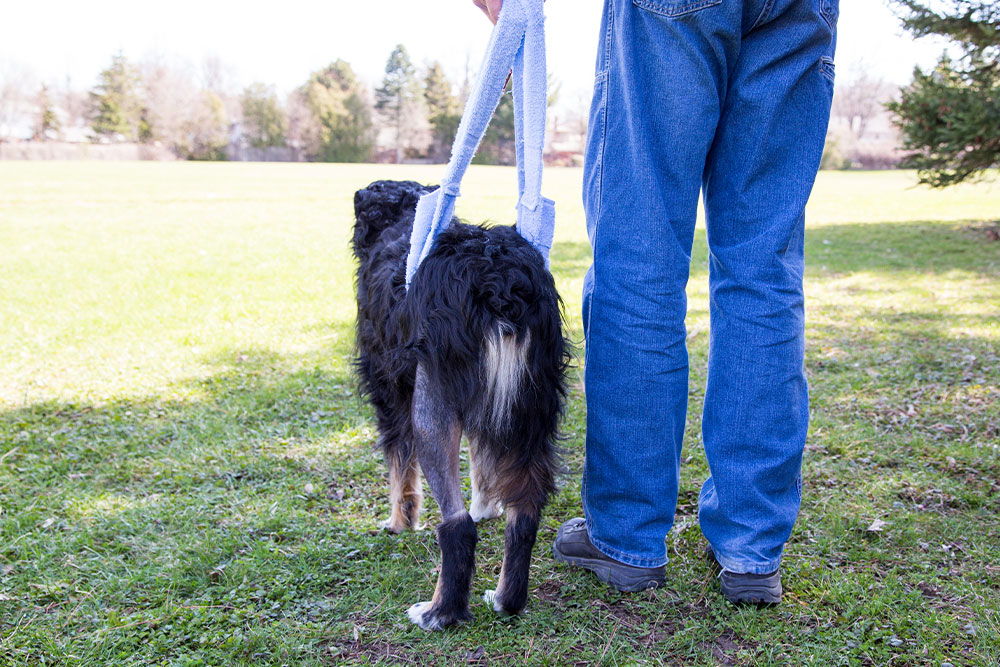
- Support harnesses for safer movement: our pharmacy carries lifting harnesses for the days a wobbly dog needs help outside.
Once the surgical recovery is behind you, the long-term work is protecting both knees, since dogs who tear one cruciate are at meaningfully higher risk of tearing the other:
- Weight control: the single highest-leverage protection, since every extra pound multiplies the load on both stifles.
- Gentle warm-ups and cooldowns around activity take meaningful load off the joints.
- Joint support: omega fatty acids and hip and joint supplements help reduce inflammation and provide ingredients that heals cartilage.
Frequently Asked Questions About Torn CCLs
If My Dog’s Limp Comes and Goes, Is It Still Serious?
Usually yes, and the on-and-off pattern is actually the most commonly missed presentation. An intermittent limp typically signals a partial tear, where the ligament is failing in stages, and each flare reflects the joint working harder to compensate. Catching it during this phase, before a complete tear and secondary meniscal damage, gives your dog more and better options, so a recurring limp is worth evaluating rather than waiting out.
Will My Dog Get Arthritis Even With Surgery?
Usually some arthritis is already present by surgery, because the joint was unstable beforehand. Surgery dramatically slows the progression compared with leaving the tear untreated, though it cannot reverse damage already done. Most surgically treated dogs do well for years, with lean body condition and joint support keeping them comfortable longer.
Can My Dog Tear the Other CCL?
It is a real risk. Roughly 40 to 60 percent of dogs who tear one CCL go on to tear the opposite knee within one to two years, partly because that leg bore extra weight during recovery. Keeping your dog lean and conditioning steadily lowers the odds, and we watch the other knee at rechecks.
Why Do You Refer Out for the Surgery Instead of Doing It Here?
Cruciate surgery is a specialty orthopedic procedure that benefits from the equipment, expertise, and case volume of a board-certified surgical specialist. Referring these cases means your dog gets the best chance at a lasting result. We stay involved as your primary care team throughout: we handle the workup, coordinate the referral, and resume care after surgery for pain management, recheck visits, rehabilitation, and long-term joint support.
Is There a Way to Prevent CCL Injuries?
Largely through lifelong weight control and consistent, moderate conditioning rather than sporadic intense bursts. Some risk is genetic and conformational and cannot be erased, but a lean, well-conditioned dog faces meaningfully lower odds. Our preventive care and breed-specific preventive plans build that monitoring and weight guidance into your dog’s routine.
Treating the Problem, Not Just the Pain
A torn CCL is a structural injury, and the reason it will not heal with rest is simply that rest cannot rebuild a stabilizing ligament inside a joint that never stops moving. Easing the pain is not the same as fixing the knee, and for most dogs the path back to comfortable, reliable function runs through surgery and a committed recovery, followed by the weight and joint care that protect both legs for years.
If your dog is limping or you have been hoping a knee would settle on its own, request an appointment or contact us and we will work through the diagnosis and the right plan together, so your dog gets back to comfortable, confident movement.


Leave A Comment